
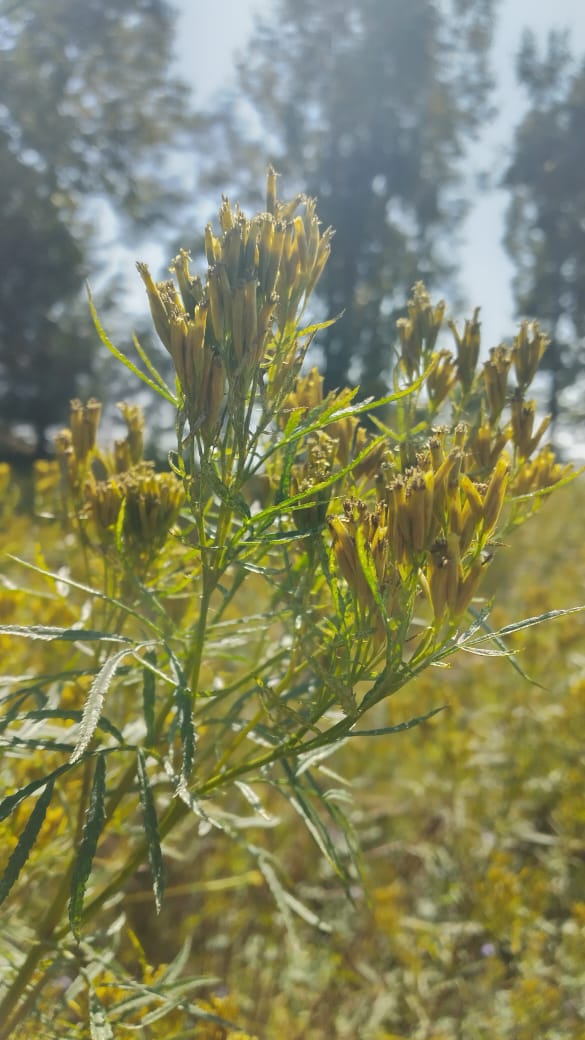
Tagetus Minuta
Introduction
The plant Tagetes Minuta is a worldwide species popularly known as wild marigold, a common English name pre historically derived from “Mary’s gold.” It belongs to the sunflower family, Asteraceae. It is naturalized in a wide range of climatic conditions worldwide but is well known to be native to North and South America. Tagetes Minuta has a long history of human use as food, perfumes, medicines, ornamentals, and in ritual and sociocultural ethnic practices, depending on geographical location and ethnic background. For instance, in Chile and Argentina, the plant is popularly known for its traditional culinary use in stews as a highly prized flavouring agent. While in many parts of the world, T Minuta is commonly used to make a hot and cold refreshing beverage as well as herbal tea, a characteristic that has given it the potential to become a new crop for many of the drug-growing areas of the world
Wild marigold (Tagetes minuta L.) is a highly demanded aromatic plant, having great industrial value The essential oil of T Minuta is used in many ways, predominantly as flavouring and seasoning agent, and/or imparting aroma in a wide range of foodstuffs and beverages, depending on the essential oil’s main constituents. Major constituents of its essential oil are β-ocimene, dihydrotagetone, tagetone, tagetenone, and limonene.
Recently farmers are more interested in its cultivation and are opting it in their cropping system. The Current market demand for tagetes oil is increasing at a faster rate due to its large use in flavour and perfumery industry. Tagetes Minuta is now a widespread weed in Africa, South Europe, South Asia, Madagascar, and Australia. Tagetes Minuta is rich at both high and low altitudes and in either high or low rainfall environments and is often found growing in disturbed areas during early plant successional stages. In the end of its growing season, the aerial parts of T Minuta dry up and may easily be destroyed by fire, but new colonies are formed rapidly in the following season from seeds deposited in the soil. Tagetes Minuta tolerates a soil pH between 4.3 and 7.0.
USAGE AND APPLICATIONS OF TAGETES OIL IN FOOD SCIENCE
• Traditionally, the plant has a long history of interaction with humanity and henceforth, its applications to the pharmaceutical and nutraceutical industries, more particularly the preparation of teas and popular potato dish called Ocopa in South America.
• Infusions, tinctures, and juice from aerial parts of Tagetes, have been used as traditional food additives worldwide.
• This traditional claim provided leads into research to help explain the underlying science and as a result. For example, an orange—yellow carotenoid lutein substance found in the florets of many marigolds (Tagetus Minuta included) has been identified, isolated, and approved by the European Union (INS-Number E161b) for use as a food colour and flavour in various foodstuffs, at a usage level in condiments and relishes such as pasta, vegetable oil, margarine, mayonnaise, salad dressing, baked goods, confectionery, dairy products, ice cream, yogurt, citrus juice, and mustard.
• Tagetes oil is therefore a potential agent for protecting food crops on the farm and in storage, thereby increasing food security, particularly in undernourished communities of the world.
• The oil also provides an opportunity for developing an environmentally friendly and a nontoxic acaricide to enhance increased production of milk, beef, and hides/skin in the livestock industry.
• The oil is rich in secondary metabolites, including acyclic, monocyclic and bicyclic monoterpenes, sesquiterpenes, flavonoids, carotenoids, and thiophenes.
• Furthermore, the Tagetes species can be unambiguously differentiated taxonomically by the chemical composition of their essential oils.
Uses
➢ Tagetes is used for digestive tract problems including poor appetite, gas, stomach pain, colic, intestinal worms, and dysentery. It is also used for coughs, colds, mumps, fluid retention, and sore eyes; and causing sweating.
➢ Women use tagetes to start menstruation, treat sore breasts (mastitis), and protect against miscarriage.
➢ People sometimes apply oil directly to the skin for treating sores and ulcers. It is used as a mosquito repellent.
➢ The OIL is put on the skin for treating wound maggots.
➢ In manufacturing, the oil is used as a fragrance in perfumes.
Our Cultivation
We are cultivating and collecting from the high-altitude areas of Himachal Pradesh. We are associated with farmers in Tissa, Palampur and Kullu areas of Himachal. Cultivating season is June. Nursery is being prepared in June and Replanting is in July. It will be grow enough to be distillation ready by October end and November.
• Tagetes minuta essential oil has a strong, sweet, wild, fruity, and slight citrus-like aroma. It has a yellow to reddish—amber coloration with an intermediate viscosity, which may well turn thick and even gel-like upon exposure to air at length due to easy polymerization.
Oil colour
 Gan Eden Biotic